

Beyond design: A $953K annual return
Service Victoria is the digital platform for citizens and businesses to “get things done with the Victorian government.” To ensure a consistent, efficient, and user-centric experience, the development of a comprehensive design system, Atom, was undertaken in late 2020. This case study outlines the process of designing and building Atom, from its inception to its successful implementation.
The challenge & the solution
Before Atom, Service Victoria faced a growing challenge: inconsistent user experiences and inefficient workflows were slowing down our ability to deliver new services to citizens. A thorough audit of the existing digital landscape revealed three key issues:
- Inconsistent experiences: Different services had varying visual styles and interactions, causing user confusion.
- Inefficient workflows: Design and development teams were duplicating efforts, leading to longer time-to-market.
- Scalability issues: Maintaining consistency and adding new features became increasingly complex as the platform grew.
We identified a design system as the strategic solution to these challenges, providing a unified design language, reusable components, and a streamlined workflow.
Project details
- Project: Service Victoria Design System
- Role: Design System Lead
- Team: 2 x UX Designer, 1 x Interaction Designer
- Timeline:
- Project endorsed: December 2020
- Beta release: March 2021
- Alpha release: May 2021
Building the system
To lay the foundation for Atom, we conducted a robust research and design phase.
- Research & discovery: Our process kicked off with a deep dive into existing assets, user needs, and industry best practices. We performed a comprehensive audit of current designs and a competitive analysis of other successful systems, all while ensuring compliance with accessibility standards from the outset.
- Methodology: We collaborated to adopt the Atomic Design methodology to structure the system, breaking it down into atoms (basic elements like buttons), molecules (groups of atoms like search bars), and organisms (complex components like forms).
- Visual language: A comprehensive visual language was developed to unify the platform, including a curated colour palette, legible typography, and a consistent iconography set.
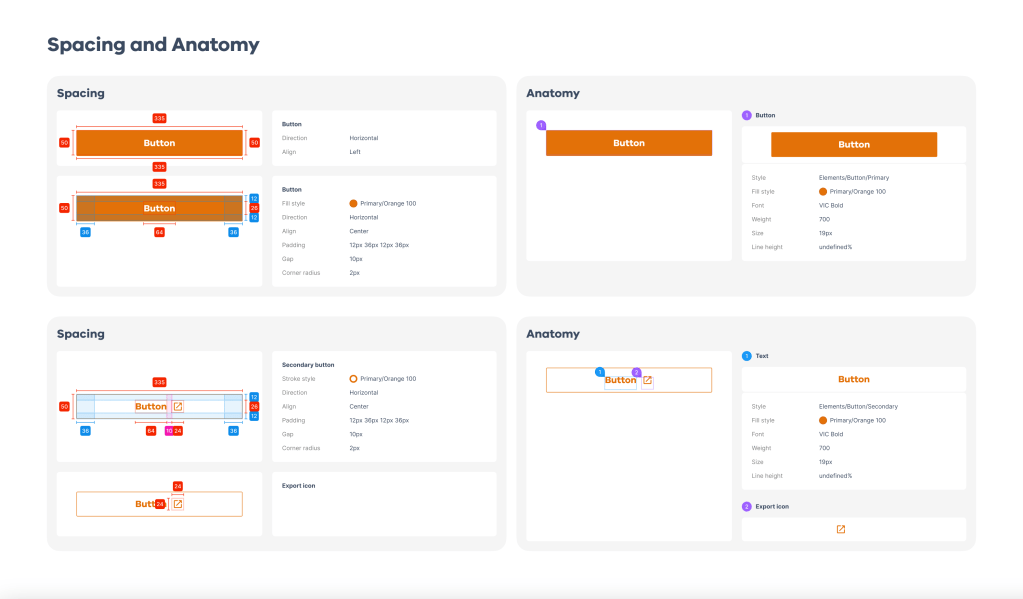
- Component library: Our teams then built a robust component library using Figma and the React framework. Every component was meticulously designed, documented, and made accessible to both designers and developers.
- Content as components: We innovated and created all of our content using components. The impact of this was immediately felt by our team, as one team member noted:
This innovation saved hundreds of design hours for content when it was implemented, tasks that took days came down to hours, even minutes in some cases.

Implementation and governance
To ensure Atom’s long-term success, we implemented a phased approach.
- Pilot projects: The system was first tested on specific projects, allowing us to gather valuable feedback and refine the system in a real-world environment.
- Training & education: We provided training to design and development teams to ensure effective and consistent use of the new system.
- Continuous improvement: We established a governance model to facilitate ongoing maintenance, feedback collection, and iterative updates, treating Atom as a living product.
Quantifying the value
To measure Atom’s impact beyond qualitative feedback, we quantified the return on investment (ROI) by estimating the time and cost savings for our teams.
Our calculations are based on a conservative estimate of 2 minutes saved per component insert and a blended average hourly rate for a mid-level UX Designer and Front-End Developer in Australia of $55 AUD/hour.
Using our adoption metrics—including over 10,000 component inserts per week—the Atom Design System saves teams an estimated 333 hours every week.
This translates to a financial value of over $18,000 AUD per week, or an annual saving of approximately $953,000 AUD.
To provide a transparent view of our methodology, here is a detailed breakdown of the calculation:
| Metric | Value | Calculation / Notes |
| Time Saved per Component | 2 minutes | A conservative estimate for the time saved by a designer or developer. |
| Average Hourly Rate | $55 AUD | Blended rate for a mid-level UX Designer and Front-End Developer in Australia. |
| Component Inserts per Week | 10,000+ | Based on platform adoption metrics. |
| Total Hours Saved per Week | 333 hours | (10,000 inserts x 2 minutes) / 60 minutes |
| Weekly Financial Value | $18,000 AUD | 333 hours x $55 AUD/hour |
| Annual Financial Value | $953,000 AUD | $18,000 AUD/week x 52 weeks |
Applying the value
The nearly one million dollar annual savings from the Atom Design System can be strategically applied to benefit the organisation in the following ways:
1. Reinvesting for future growth
The annual savings can be reinvested into the business to drive innovation and growth. This allows for the accelerated development of new products and services that directly benefit the end user. By freeing up capital, Service Victoria can focus on more complex, high-value projects and invest in emerging technologies.
2. Boosting team productivity and morale
The efficiency gains are not just about saving money; they’re about empowering your team. The time saved—equivalent to adding 8-9 full-time employees—allows designers and developers to focus on creative, rewarding work rather than repetitive tasks. This leads to higher job satisfaction and improved employee retention, which in turn reduces the high costs associated with staff turnover.
3. Enhancing product quality and consistency
Atom acts as a single source of truth, ensuring a consistent and polished user experience across all digital products. This investment reduces technical debt, prevents the accumulation of design inconsistencies, and builds a stronger, more reliable brand identity. Furthermore, it ensures that accessibility is built in from the start, making products more inclusive and compliant.
Conclusion
Ultimately, the development of the Atom Design System has proven its value, not just through improved efficiency and user experience, but by delivering a clear annual return of nearly $953,000 AUD.
This success story demonstrates that a well-crafted design system is more than a design tool—it’s a strategic business asset that drives both operational excellence and future innovation.
 Jarrod Vanstan