
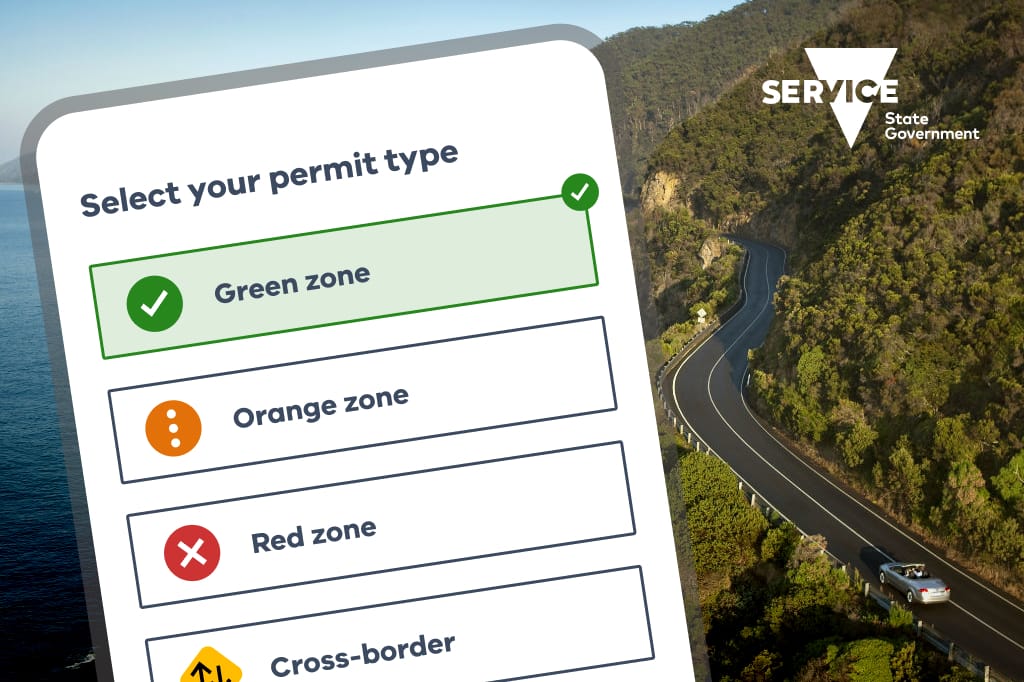
Over 4 million permits: A case study in crisis-driven design
The COVID-19 pandemic presented a unique and urgent challenge for the Victorian government: to swiftly and securely manage the entry of millions of people across state borders. The COVID-19 Border Entry Permit was a critical digital service designed to meet this challenge, enabling the safe movement of citizens while ensuring public health.
This case study outlines the rapid design, development, and deployment of a high-stakes digital product under immense pressure and highlights the key insights gained from the experience.
The challenge & the solution
The primary challenge was to build a secure, reliable, and user-friendly system from scratch in an incredibly short timeframe. The platform needed to handle an unprecedented volume of applications, communicate complex public health rules clearly, and adapt instantly to a constantly changing health landscape.
We delivered a streamlined, accessible application and a PDF permit that had a unique QR code which authorised officers could scan with an app to verify its validity. This solved a critical logistical problem for millions of Victorians and travellers.
The original solution was designed for travellers entering Victoria by road. They could print the PDF and place it on their vehicle’s dashboard, allowing authorised officers to scan the QR code through the window.
While this was an excellent solution for road travellers, it was not suitable for those arriving by plane or boat. Many of these travellers were not prepared and needed to apply for the permit at the terminal, slowing down both the traveller and the authorised officer and creating congestion.
Project details
- Project: COVID-19 Border Entry Permit
- Role: Lead Product Designer
- Timeline: Monday 11 January 2021 at 11:59pm, introduction of the Traffic Light System – Friday, 18 February 2022 at 6pm, the permits were retired.
- Key Stats: Over 4.2 million permits were issued during this time.
The Traffic Light System
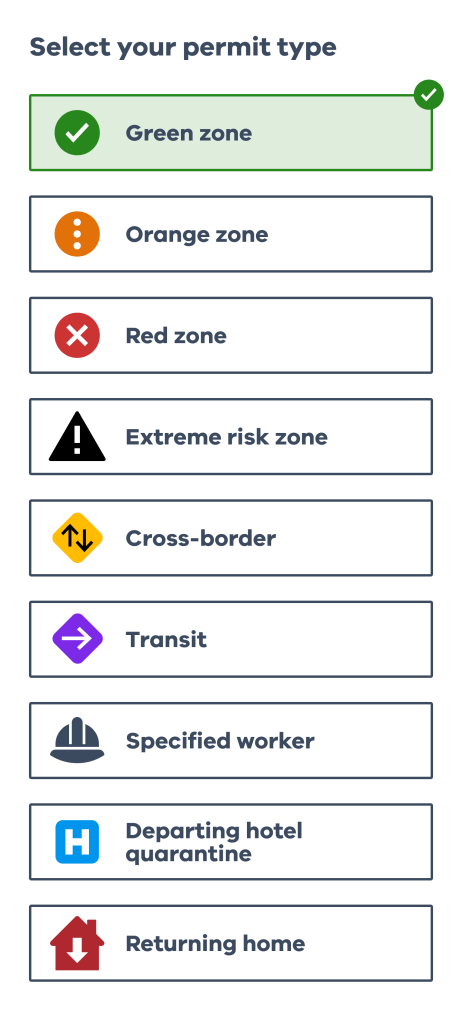
The border entry permit was built to support the national traffic light system, which was used to categorise local government areas (LGAs) across the country based on their COVID-19 risk level. This system defined the eligibility criteria for entering Victoria and was a key piece of information that the permit application needed to communicate clearly to users.
- Green Zone: LGAs with no active cases. Travellers who had only been in a green zone were free to enter Victoria with a permit.
- Orange Zone: LGAs with some COVID-19 cases. Travellers from these zones were required to get tested, monitor for symptoms, and isolate if they felt unwell.
- Red Zone: LGAs with a high number of cases. Entry from these zones was severely limited, and only Victorian residents returning home or those with a valid exemption were permitted to enter.

Key responsibilities & impact
As a Lead Product Designer, I was responsible for ensuring a consistent user experience, managing the design workflow, and maintaining an agile and responsive approach to a rapidly evolving project. The permits were ultimately retired on Friday, 18 February at 6 pm, marking the successful conclusion of a project that played a vital role in managing the state’s response to the pandemic.
- Agile by necessity: The project required a highly agile approach, with constant communication and iteration as health rules changed daily.
- Designing for clarity: We focused on making complex eligibility rules and public health advice easy for users to understand, reducing confusion and anxiety.
- Collaboration under pressure: Our small, dedicated team worked hand-in-hand with policy advisors and developers to launch the product in record time, proving that effective collaboration can overcome immense pressure.
Navigating constant change: The challenges faced
Our team faced a constant stream of challenges that were inherent to the nature of the pandemic. What began as a simple system with three permit types quickly grew in complexity as public health needs evolved.
Expanding permit types
The original three permit types expanded to include up to nine options:
- Extreme Risk Zone Exemption
- Cross-border Community Permit
- Transit Permit for people travelling through Victoria for less than 24 hours.
- Specified Worker Permit for single or multiple entries.
- Departing Hotel Quarantine Permit
- Returning Home Permit for Victorian residents with special reasons to return, such as reuniting with family, schooling, or for medical and relocation purposes.
Evolving evolving rules
The constant changes to eligibility criteria and the number of permits a traveller could apply for required us to be exceptionally agile, adapting the system and user experience in real-time to prevent user confusion.


Lessons learned
The project’s success was defined by its speed and direct impact, but a high-stakes environment always offers opportunities for reflection. If I could do it again, I would:
- Improve the user flow: I would redesign the flow of the transaction to allow users to provide their travel details first, and their personal details second. This would improve the experience by allowing them to select the permit type they need before they enter their personal details.
- Solve the PDF problem: While the PDF could be viewed on a mobile phone, travellers needed to open it from their email, which was a slow process. I would have advocated for an option to save the permit QR code to the traveller’s device instantly from the “Done” screen, or allow the permit to be added to the Service Victoria app’s digital wallet for real-time updates.
- Enable account-based pre-fill: For Service Victoria account holders, I would enable the prefilling of personal details. Given that many travellers needed to apply for a permit multiple times, a simpler “Same permit as last time” option would have significantly reduced the time to complete the application by over 50%.
- Allow group applications: I would include an option to “add another traveller” to a single application. While separate permits were required for each traveller over 12 years of age, grouping permits for families or groups would have reduced the time for them to complete the application and the time for authorised officers to scan each individual permit.
Conclusion
The COVID-19 Border Entry Permit stands as a powerful example of what is possible when a clear purpose meets a dedicated team. The project demonstrated my ability to not only design and manage a product under extreme pressure but also to deliver a critical service that was used by over four million people. It was a career-defining project that taught invaluable lessons about leadership, communication, and the power of user-centric design in a crisis.
 Jarrod Vanstan